
“And you shall set the table outside the veil, and the lampstand on the south side of the tabernacle opposite the table, and you shall put the table on the north side.” Exodus 26:35
In the Tabernacle, God gave Israel a beautiful picture of His desire for fellowship. The table of showbread (also called the bread of the Presence) stood in the Holy Place, just outside the veil that separated the priests from the Most Holy Place where God’s glory dwelt above the Ark.
This table was never empty. Twelve loaves of bread, one for each tribe of Israel, were placed on it every Sabbath and remained continually before the Lord (Exodus 25:30). The priests ate the old bread in God’s presence. Illuminated by the golden lampstand, the table spoke of God’s faithful provision, covenant relationship, and invitation to commune with Him.
Yet the veil remained. Access was limited. Only priests could enter the Holy Place, and even then, full entry into God’s immediate presence was rare and dangerous. The table represented real but incomplete fellowship—a foretaste of intimacy that the old covenant could not fully deliver because of sin’s barrier.
Everything the table pictured finds its perfect fulfillment in Jesus. He declared, “I am the bread of life; whoever comes to me shall not hunger, and whoever believes in me shall never thirst” (John 6:35). On the cross, Jesus’ body was broken for us. When He died, the veil in the Temple was torn from top to bottom (Matthew 27:51). The barrier is gone. Hallelujah!
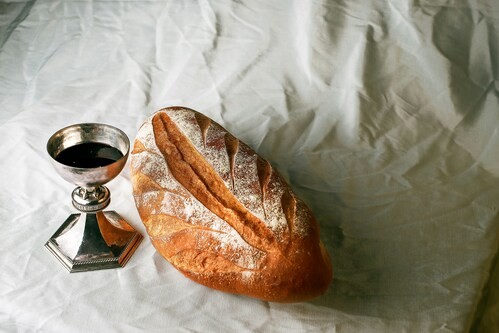
Through His blood, we now have bold access into the very presence of God (Hebrews 10:19-22). The Lord’s Supper is the new covenant fulfillment of the showbread table. When we take the bread and cup, we remember Christ’s sacrifice and proclaim His death until He comes. No more distant priests. No more veil. We are invited to feast on Christ Himself who is our daily bread, our sustaining presence, our eternal portion.
Remember Mephibosheth? Crippled, hiding in Lo-debar (“land of no pasture”), son of Jonathan but heir to a defeated house. King David sought him out not for repayment, but for the sake of covenant love (hesed). He brought the lame man to his own table to eat “always” as one of the king’s sons (2 Samuel 9).
This is our story. We were spiritually crippled by sin, far from the King. Yet Jesus, the greater David, sought us, lifted us from the dust, and seated us at His table. We eat “always” because of grace alone. Our place is secure not by our strength or worthiness, but by the King’s kindness displayed at Calvary.
Today you can experience this reality as you come to the table in prayer and worship, feeding on Christ through His Word. You can gather with believers for communion, tasting afresh the grace that welcomes you. You can live with the confidence that nothing can remove you from the King’s presence. Even in weakness, you belong. The table is spread for you.
Moreover, those who have received such astonishing grace must become agents of that same grace. Look around your circle: family, coworkers, neighbors, friends who feel crippled by shame, failure, addiction, or loss. Many are living in their own “Lo-debar,” convinced they have no seat at any table of love or belonging.
Will you seek them out as David did? Will you show the kindness of Jesus? Invite them not just to a meal, but to the gospel—the good news that there is a place for them at the King’s table because Jesus paid for it with His life. Share salvation boldly and love practically. Your table (literal or figurative) can become a doorway for someone else to discover the Table of the Lord.
May our lives declare Christ’s welcome: “There is a place for you.” In your name Jesus, Amen.
In the Tabernacle, God gave Israel a beautiful picture of His desire for fellowship. The table of showbread (also called the bread of the Presence) stood in the Holy Place, just outside the veil that separated the priests from the Most Holy Place where God’s glory dwelt above the Ark.
This table was never empty. Twelve loaves of bread, one for each tribe of Israel, were placed on it every Sabbath and remained continually before the Lord (Exodus 25:30). The priests ate the old bread in God’s presence. Illuminated by the golden lampstand, the table spoke of God’s faithful provision, covenant relationship, and invitation to commune with Him.
Yet the veil remained. Access was limited. Only priests could enter the Holy Place, and even then, full entry into God’s immediate presence was rare and dangerous. The table represented real but incomplete fellowship—a foretaste of intimacy that the old covenant could not fully deliver because of sin’s barrier.
Everything the table pictured finds its perfect fulfillment in Jesus. He declared, “I am the bread of life; whoever comes to me shall not hunger, and whoever believes in me shall never thirst” (John 6:35). On the cross, Jesus’ body was broken for us. When He died, the veil in the Temple was torn from top to bottom (Matthew 27:51). The barrier is gone. Hallelujah!
Through His blood, we now have bold access into the very presence of God (Hebrews 10:19-22). The Lord’s Supper is the new covenant fulfillment of the showbread table. When we take the bread and cup, we remember Christ’s sacrifice and proclaim His death until He comes. No more distant priests. No more veil. We are invited to feast on Christ Himself who is our daily bread, our sustaining presence, our eternal portion.
Remember Mephibosheth? Crippled, hiding in Lo-debar (“land of no pasture”), son of Jonathan but heir to a defeated house. King David sought him out not for repayment, but for the sake of covenant love (hesed). He brought the lame man to his own table to eat “always” as one of the king’s sons (2 Samuel 9).
This is our story. We were spiritually crippled by sin, far from the King. Yet Jesus, the greater David, sought us, lifted us from the dust, and seated us at His table. We eat “always” because of grace alone. Our place is secure not by our strength or worthiness, but by the King’s kindness displayed at Calvary.
Today you can experience this reality as you come to the table in prayer and worship, feeding on Christ through His Word. You can gather with believers for communion, tasting afresh the grace that welcomes you. You can live with the confidence that nothing can remove you from the King’s presence. Even in weakness, you belong. The table is spread for you.
Moreover, those who have received such astonishing grace must become agents of that same grace. Look around your circle: family, coworkers, neighbors, friends who feel crippled by shame, failure, addiction, or loss. Many are living in their own “Lo-debar,” convinced they have no seat at any table of love or belonging.
Will you seek them out as David did? Will you show the kindness of Jesus? Invite them not just to a meal, but to the gospel—the good news that there is a place for them at the King’s table because Jesus paid for it with His life. Share salvation boldly and love practically. Your table (literal or figurative) can become a doorway for someone else to discover the Table of the Lord.
May our lives declare Christ’s welcome: “There is a place for you.” In your name Jesus, Amen.
Recent
Archive
2026
January
February
March
April
May
June
July
2025
February
March
April
May
June
July
August
September
October
November
2024
January